

The latest violence in Shillong is not merely another law-and-order incident. It is a warning about what happens when legitimate concerns about indigenous identity, migration and environmental pressure are allowed to slide into an exclusionary politics of “insiders” and “outsiders”.
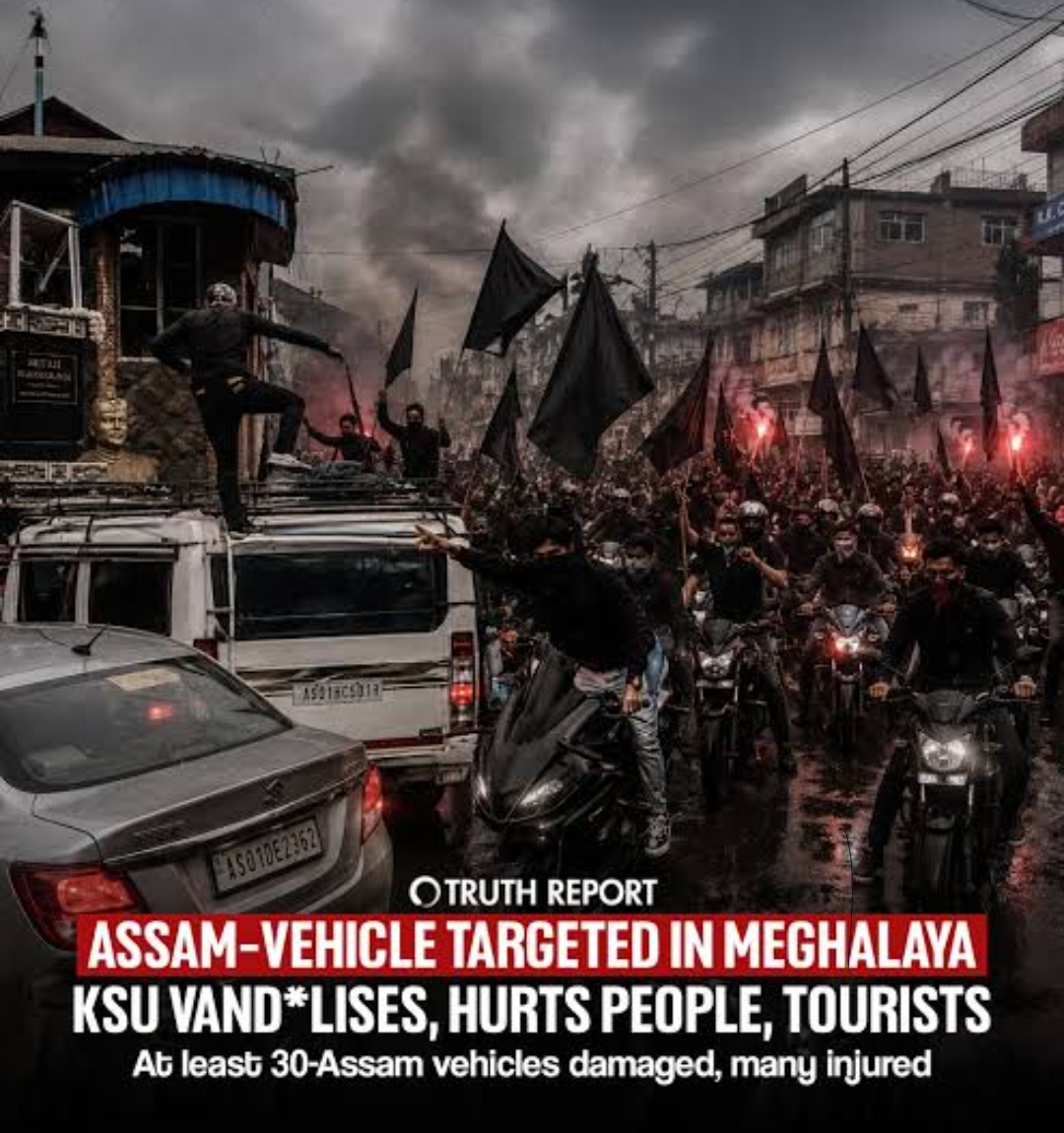
On August 19, 2026, a black-flag motorcycle rally organised by the Khasi Students’ Union (KSU) in Shillong turned violent. Police said 31 vehicles were damaged, two government vehicles were set ablaze and people were assaulted at different places. Vehicles bearing Assam registration numbers were among those targeted. Statues of Swami Vivekananda and Netaji Subhas Chandra Bose at a refugee settlement were also allegedly vandalised. Three senior KSU leaders were subsequently arrested in connection with the violence.
The reaction in Assam was swift. Taxi and commercial-vehicle operators blocked Meghalaya-registered vehicles at Jorabat and Khanapara, disrupting the vital Guwahati-Shillong corridor. Meghalaya taxi operators have subsequently suspended Shillong-Guwahati services and demanded adequate security for passengers and drivers.
This is precisely the point at which responsible leadership is required on both sides. Retaliatory blockades against ordinary Meghalaya residents are no solution. But neither can attacks on Assam-registered vehicles, tourists or other non-Khasi residents be dismissed as an expression of political protest.
The violence must be condemned without qualification.
The troubling timing of a debate on tourism
Two days before the violence, journalist Patricia Mukhim wrote about the “tourist overload” in Meghalaya and complained that local residents could not even drive out of Shillong on weekends without getting trapped in traffic on the Sohra highway. She asked whether Meghalaya had effectively “sold” its land to tourism promoters and argued that the environment should not become a corporate-owned asset.
There is an important concern in that argument: uncontrolled tourism can damage fragile ecosystems, overload roads, create waste and make life difficult for local residents. Meghalaya certainly needs a serious tourism-carrying-capacity policy.
But the larger conclusion deserves challenge.
Tourism is not inherently an external corporate asset. Properly organised, it can be one of Meghalaya’s greatest instruments of local economic empowerment.
The Meghalaya Government itself reported that 16 lakh tourists visited the state in 2024, a 13.04 per cent increase over 2023. It valued the tourism industry at about ₹1,600 crore in 2022 and projected it to reach ₹12,000 crore by 2028. The state has also allocated ₹600 crore for tourism infrastructure in the 2025-26 budget.
Those visitors are not simply passing through.
They stay in hotels and homestays. They hire taxis and tourist vehicles. They eat in restaurants. They buy local handicrafts. They employ guides. They visit villages, waterfalls, caves and markets. They pay for parking, entry tickets, adventure activities and local services.
The answer to congestion, therefore, is not to discourage tourists or make them feel unwelcome. The answer is to build enough infrastructure to accommodate them.
If Shillong is overcrowded, develop alternative tourist centres. If Sohra is congested, promote tourism in other parts of Khasi, Jaintia and Garo Hills. If hotels are insufficient, encourage regulated community-based homestays. If roads are inadequate, expand and redesign them. If waste management is failing, establish modern solid-waste and sewage systems.
The state should turn tourism from a seasonal burden into a year-round decentralised economic opportunity.
Meghalaya’s history is inseparable from Assam’s
There is another uncomfortable historical fact that needs to be remembered.
Meghalaya did not emerge in isolation from Assam. Shillong was made the capital of Assam in 1874 and remained Assam’s capital until Meghalaya became a full-fledged state in 1972. Meghalaya first became an autonomous state within Assam on April 2, 1970, before becoming a separate state on January 21, 1972. The North-Eastern Areas (Reorganisation) Act, 1971 formally provided for the formation of Meghalaya by reorganising territories of the existing State of Assam.
The creation of Meghalaya was the result of a long political movement for greater autonomy and recognition of the distinct identity of the hill peoples. That aspiration deserves respect.
But statehood did not erase history.
Shillong was a major administrative and commercial centre long before 1972. Bengalis, Assamese, Nepalis, Marwaris, Punjabis and people from other parts of India lived and worked there. They were teachers, clerks, doctors, traders, labourers, government employees and professionals. Historian Binayak Dutta has described this as a multi-ethnic space in which different communities contributed to the development of Shillong.
Therefore, the creation of Meghalaya cannot be interpreted as the creation of a territory in which every person who is not Khasi, Jaintia or Garo automatically becomes an “outsider”.
India’s federal map has changed many times. States have been created to protect language, culture and political aspirations. But once a state is created, its citizens remain citizens of India.
A painful history of minorities
The present crisis also cannot be discussed without acknowledging Meghalaya’s history of ethnic violence.
In 1979, Shillong witnessed serious violence against non-tribals, particularly Bengalis. Contemporary records describe arson, assaults and people being dragged from their homes. The Indian Express archive records that mobs were involved in arson and assaults and that the Army had to be deployed after police action failed to control the violence.
The violence did not end there.
In 1987, the Khasi Students’ Union spearheaded an agitation against non-tribal “outsiders”. The Union demanded, among other things, an Inner Line regime and removal of foreigners and non-tribals from electoral rolls. The Union’s agitation produced serious violence; the Ministry of Home Affairs recorded 12 deaths in the Khasi Hills between June 1987 and January 1988 and reported that central paramilitary forces had to be deployed.
The targets changed over time: Bengalis in 1979, Nepalis in 1987 and Biharis in 1992. The Indian Express has documented this recurring pattern.
The 2018 violence around Shillong’s Punjabi Lane demonstrated that the problem had not disappeared. A relatively small altercation between Khasi bus workers and residents of the long-established Sikh settlement escalated into days of violence, curfew and clashes. The Sikh community had lived in Shillong for generations; some families had been there for more than a century.
In 2020, violence again erupted around Ichamati amid tensions over the Citizenship Amendment Act and demands for an Inner Line Permit. The Indian Express noted that violence against non-tribals in Meghalaya had repeatedly followed the politics of “outsiders” over four decades.
This history should not be used to stigmatise Khasi society as a whole. The overwhelming majority of Khasi people are peaceful citizens. Nor should the actions of a student organisation be treated as the collective responsibility of an entire community.
But the history cannot be erased either.
The danger of turning protection into exclusion
There is a legitimate constitutional and political principle behind protecting indigenous communities.
Meghalaya has special protections under the Sixth Schedule. Its tribal communities have genuine concerns about land, employment, cultural survival and demographic change. These concerns cannot simply be dismissed as “ultra-nationalism”.
But there is a fundamental difference between protecting indigenous rights and creating a culture of permanent suspicion against fellow Indian citizens.
The first strengthens federalism.
The second weakens it.
The Inner Line Permit debate illustrates this contradiction.
The ILP system originated under the Bengal Eastern Frontier Regulation of 1873, a colonial instrument designed to regulate the movement of people into protected frontier areas. Today it exists in modified form in Arunachal Pradesh, Nagaland, Mizoram and Manipur. Meghalaya has repeatedly demanded its extension to the state.
Indeed, the issue remains alive. In February 2026, Chief Minister Conrad K. Sangma told the Meghalaya Assembly that the state was examining an ILP-like legal framework and was discussing the matter with the Union Home Ministry. The state is also implementing the Meghalaya Residents Safety and Security Act, which provides for verification and regulation of tenants and the establishment of district task forces.
The legitimate question is not whether Meghalaya should protect itself from illegal immigration, trafficking, organised crime or unregulated migration. Of course it should.
The question is whether a colonial-era entry-control philosophy is the best instrument for a modern democratic state.
An ILP-type system should not become a psychological permit system — a mechanism by which an Indian tourist from Assam, Bengal, Punjab or Maharashtra is made to feel that he is entering a foreign country.
That would be neither good for Meghalaya nor good for India.
Assam also has a responsibility
Assam cannot claim the moral high ground automatically.
The Northeast has a painful history of ethnic movements, xenophobia and violence, including the Assam Agitation and attacks on minorities. Assam too has witnessed episodes in which linguistic or ethnic identity was weaponised against fellow citizens.
Therefore, the answer cannot be a competition over who has suffered more.
The present blockade at Jorabat is understandable as an expression of anger among transporters after vehicles and passengers from Assam were attacked. But prolonged blockade will ultimately hurt ordinary people on both sides — students, patients, workers, traders, tourists and families. It also risks creating precisely the kind of retaliatory cycle that responsible governments should prevent.
Assam and Meghalaya are economically and geographically intertwined.
For Meghalaya, Assam is the principal gateway to the rest of India.
For Assam, Meghalaya is an important tourism destination, a neighbouring market and part of the larger Northeast economic ecosystem.
Neither can prosper by closing the road to the other.
The way out: from confrontation to a Meghalaya-Assam compact
The permanent solution requires something more ambitious than police deployment after every riot.
First, establish an Assam-Meghalaya Peace and Mobility Council. The two Chief Ministers should create a permanent institutional mechanism involving ministers, police, transporters, tourism bodies, student organisations, traditional institutions, civil society and minority representatives. It should meet regularly, not only after violence.
Second, create a Tourist Safety Protocol. Tourist vehicles must be protected irrespective of their registration number. Meghalaya should establish designated tourist corridors, emergency helplines, traffic-management systems, parking facilities and police assistance at major destinations.
Third, decentralise tourism. Shillong and Sohra cannot carry the entire burden. Tourism should be developed in Garo Hills, Jaintia Hills, Ri-Bhoi and lesser-known Khasi destinations. Rural tourism, homestays and community tourism can ensure that the economic benefits reach villages rather than a handful of large investors.
Fourth, make the local community the principal beneficiary. Tourism licences, homestay schemes, guides, transport services, food outlets and handicraft markets should give priority to local entrepreneurs. If Khasi, Jaintia and Garo youth see tourism as an employment opportunity rather than a threat, hostility will naturally diminish.
Fifth, enforce responsible tourism. Tourists must respect local customs, dress codes where applicable, environmental regulations and traffic rules. Meghalaya should not hesitate to penalise littering, drunken behaviour, reckless driving or damage to natural sites.
Sixth, protect minorities through law, not political assurances. Any attack on a Bengali, Nepali, Sikh, Assamese or any other Indian citizen must be treated as an attack on an Indian citizen. Fast investigation, prosecution and compensation should become the norm.
Seventh, separate illegal immigration from Indian mobility. Illegal foreign immigration is a legitimate security issue. An Indian family from Guwahati travelling to Sohra is not an illegal immigrant. A tourist from Kolkata is not an infiltrator. A Sikh businessman from Punjab is not a foreigner. Public policy must maintain this distinction with absolute clarity.
Finally, confront hate politics itself. Organisations have every democratic right to protest. They have no democratic right to attack civilians, burn vehicles or vandalise national icons. Equally, retaliatory violence from Assam must be rejected.
Meghalaya’s future should be bigger than its anxieties
The tragedy of Meghalaya is that the state possesses precisely the natural and cultural advantages that millions of people want to experience, yet periodically finds itself debating whether those visitors should be allowed to come.
That is the wrong question.
The right question is: How can Meghalaya welcome visitors without allowing tourism to destroy the environment or overwhelm local communities?
There is a sophisticated answer.
Build infrastructure. Regulate numbers where necessary. Spread tourists geographically. Strengthen public transport. Promote homestays. Develop rural tourism. Make local communities shareholders in the tourism economy. Protect forests and water resources. Enforce environmental standards. And guarantee the safety and dignity of every visitor.
The Khasi, Jaintia and Garo peoples have every right to protect their land, culture and identity. But their security does not require the insecurity of others.
Likewise, Assam has every right to demand safety for its citizens travelling to Meghalaya. But Assam’s anger should not turn into collective punishment of Meghalaya’s people.
The Shillong of the future should not be a city divided between “sons of the soil” and “outsiders”. It should be a confident Indian hill city that knows how to protect its indigenous identity while remaining open, hospitable and economically vibrant.
Meghalaya was created through a democratic reorganisation of Assam. Its future too must be shaped through democratic accommodation — not barricades, burning vehicles, vandalised statues or politics of exclusion.
The road between Guwahati and Shillong is more than a highway.
It is a reminder that geography, history and economics have bound the two peoples together.
No movement, no state boundary and no political slogan can change that reality.
The permanent answer is not to close the road.
It is to make the road safe for everyone.
