

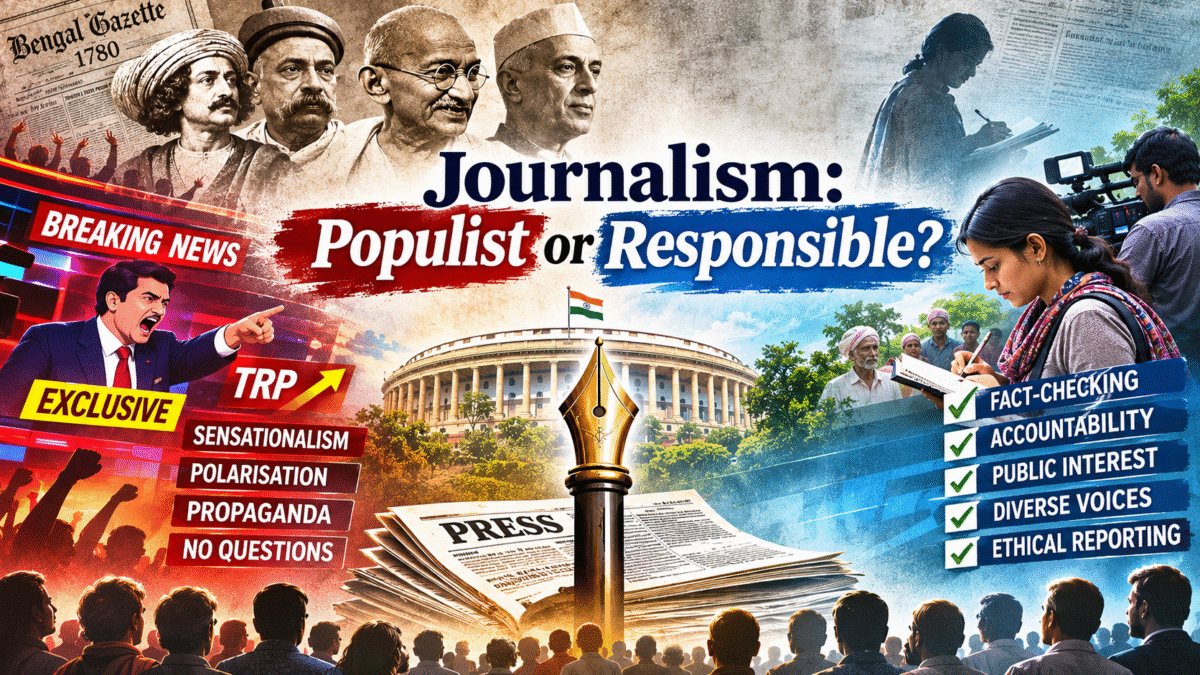
As India celebrates National Press Day on November 16, with the theme “Journalism: Populist or Responsible”, it is an appropriate moment for the media fraternity to introspect about the direction in which Indian journalism is heading. The question is not merely about journalistic ethics or professional standards. It concerns the very foundation of democracy, the right of citizens to receive truthful information and the responsibility of the press to hold those exercising power accountable. At a time when political polarisation, corporate influence, technological disruption and the race for television ratings and digital popularity are reshaping the media landscape, the distinction between populist journalism and responsible journalism has acquired unprecedented significance.
Populism in journalism is not necessarily synonymous with journalism that appeals to ordinary people. Journalism must be accessible, relevant and responsive to public concerns. The problem arises when the media begins to substitute public interest with popular sentiment, factual investigation with manufactured controversy and critical scrutiny with political propaganda. Responsible journalism, on the other hand, is not about pleasing the government, the opposition or any particular section of society. Its fundamental responsibility is to the truth, public interest and democratic accountability.
India has a remarkable history of journalism rooted in the struggle for freedom, social reform and democratic awakening. The first newspaper in India, James Augustus Hickey’s Bengal Gazette, published in 1780, demonstrated the importance of an independent press by challenging the colonial administration. Raja Rammohun Roy used journalism as an instrument of social reform and intellectual awakening. Newspapers such as Kesari, The Hindu, Amrita Bazar Patrika, The Tribune and Young India became important platforms for political mobilisation and resistance against colonial rule. Bal Gangadhar Tilak, Mahatma Gandhi, Jawaharlal Nehru, Gopal Krishna Gokhale and several other leaders understood the power of journalism not merely as a means of communication but as an instrument of public consciousness.
The colonial administration repeatedly attempted to suppress this independent spirit through restrictive legislation, including the Vernacular Press Act of 1878 and the Press Act of 1910. Yet journalists continued to challenge arbitrary authority, expose injustice and mobilise public opinion. Journalism during the freedom struggle was often openly political, but its political character was driven by the larger objective of emancipation, equality and national independence. The press was not expected to function as an extension of the colonial establishment. It was expected to question it.
That historical legacy makes the present condition of Indian journalism particularly disturbing. Seven decades after independence, a section of the mainstream media appears increasingly uncomfortable with the fundamental responsibility of questioning those in power. Much of the influential television news space has become dominated by political narratives that closely follow the ideological positions of the ruling establishment. Instead of examining government policies, questioning administrative failures and investigating allegations of corruption, some television channels devote disproportionate attention to political personalities, religious polarisation, manufactured controversies and nationalist rhetoric.
Criticism of the government is frequently presented as criticism of the nation itself. Questions about unemployment, inflation, agrarian distress, institutional accountability, communal violence, environmental degradation and civil liberties are sometimes pushed aside by politically convenient narratives. The distinction between the government, the political party in power and the nation is deliberately blurred in certain media debates. This is dangerous for democracy. A government is an elected institution, not an unquestionable authority. Its policies and decisions must remain open to public scrutiny.
The problem is not confined to political conformity. The commercialisation of journalism has created another serious crisis. Television channels compete for higher Television Rating Points (TRPs), while digital news platforms chase clicks, views, shares and online engagement. In this competitive environment, sensationalism often becomes more profitable than serious journalism. News is increasingly presented as entertainment, debate as confrontation and disagreement as a spectacle. The louder the anchor, the more dramatic the accusation and the more provocative the headline, the greater the possibility of attracting attention.
This tendency has serious consequences. Complex public issues are reduced to simplistic arguments. Unverified allegations are circulated as established facts. Individuals are subjected to trial by television studios before the judicial process has even begun. Communal tensions are sometimes aggravated through irresponsible reporting, while the voices of marginalised communities, workers, farmers, minorities and economically disadvantaged people receive inadequate attention. The media’s obligation to inform is gradually displaced by its commercial incentive to excite.
An equally serious concern is the growing concentration of media ownership in the hands of powerful corporate interests. When a few large business houses exercise considerable influence over television networks, newspapers and digital platforms, questions arise about editorial independence and conflicts of interest. Corporate groups have their own commercial interests and relationships with governments. Such circumstances can create an environment in which critical reporting becomes inconvenient. The danger is not simply direct censorship but the more subtle influence of ownership, advertising dependence and access to political power over editorial decisions.
The Reuters Institute’s Digital News Report 2025 offers important insights into this changing environment. Its India chapter highlights concentrated media ownership, pressures on independent journalists and the challenges faced by media organisations critical of those in power. It records overall trust in news in India at 43 per cent among its survey respondents. These figures should be understood in the context of the report’s methodology and are not a comprehensive measurement of every Indian news consumer. Nevertheless, they underline the continuing challenge of building public confidence in journalism.
The experience of the Emergency of 1975-77 remains an important historical warning. When the government imposed censorship, sections of the press resisted, while others surrendered their editorial independence. The episode demonstrated that freedom of the press cannot survive merely through constitutional guarantees; it also requires courage, professional solidarity and institutional commitment. The famous observation that when the press was asked to bend, some chose to crawl remains relevant even today. The methods of controlling the media may have changed, but the fundamental test of editorial independence has not.
A comparison with other established democracies is instructive. In the United States, despite the increasing political polarisation of the media and the partisan character of several news networks, investigative journalism continues to play an important role in exposing abuses of power. The Washington Post’s investigation of the Watergate scandal, which ultimately contributed to President Richard Nixon’s resignation, remains a defining example of the press functioning as a democratic watchdog. The American media environment is far from perfect, but the constitutional protection of free expression and the tradition of investigative reporting provide important institutional safeguards.
In the United Kingdom, the BBC’s public-service broadcasting tradition is built around principles of accuracy, impartiality and editorial independence. British newspapers have their own ideological positions, and their coverage is not always free from controversy. Nevertheless, the distinction between news reporting, commentary and political advocacy remains an important professional consideration. Public broadcasters in several European democracies are also expected to function independently of the government of the day, rather than serve as instruments of political publicity.
These comparisons should not lead us to romanticise Western journalism. Corporate concentration, political partisanship, misinformation, sensationalism and declining public trust are common challenges across democracies. The Reuters Institute’s 2025 global report itself identifies the growing influence of partisan media personalities and social media platforms, alongside declining engagement with traditional news organisations. The lesson is that responsible journalism requires institutional independence and professional integrity, irrespective of the political or economic system in which it operates.
India’s challenge, however, is particularly significant because of its enormous social diversity, economic inequalities and political complexity. The media must provide space for different languages, regions, communities and competing political opinions. A democracy as diverse as India cannot afford a media environment in which a narrow set of political and corporate interests determines what constitutes national discourse.
The responsibility of journalism also extends beyond questioning the government. An opposition party, a corporate conglomerate, a powerful religious organisation or an influential social institution must be subjected to the same standards of scrutiny. Responsible journalism cannot become a partisan instrument. It must investigate allegations against all centres of power without fear or favour. Equally, criticism must be based on verifiable facts, not ideological hostility.
The way forward requires a renewed commitment to professional ethics and institutional independence. The Press Council of India’s Norms of Journalistic Conduct provide an important framework for accuracy, fairness, verification, privacy and responsible reporting. These principles must be treated as essential professional obligations rather than optional guidelines. The Council must also continue to assert its role in protecting press freedom while improving journalistic standards. Its twin responsibilities are inseparable: there can be no meaningful responsibility without freedom, and freedom loses public legitimacy when it is exercised without accountability.
There is also an urgent need to examine the financial and ownership structures of media organisations. Greater transparency in media ownership, political advertising and government advertising is essential. Public advertisements should be distributed according to objective, transparent and non-discriminatory criteria rather than political loyalty or editorial preference. The economic survival of small and medium newspapers, particularly those serving regional and rural audiences, must receive serious attention. Independent journalism cannot flourish if its financial sustainability depends entirely on the goodwill of political and corporate establishments.
Media organisations must invest in investigative journalism, fact-checking, rural reporting and the training of journalists. Newsrooms should clearly distinguish news from opinion, verified information from allegations and journalism from political campaigning. Editors must be allowed to exercise independent professional judgement. Journalists must also be protected from intimidation, violence, arbitrary legal action and economic retaliation. A journalist who fears losing employment or facing prosecution for asking uncomfortable questions cannot perform the democratic function expected of the profession.
The digital revolution has created new opportunities but also new responsibilities. Social media has democratised access to information, enabling citizens and independent journalists to challenge established narratives. At the same time, algorithm-driven distribution often rewards outrage, misinformation and polarisation. Media organisations must therefore develop stronger verification mechanisms and digital literacy programmes. Artificial intelligence may assist journalism, but it cannot replace human judgement, independent investigation and ethical responsibility.
Ultimately, the central question is not whether journalism should be popular or unpopular. It should certainly be popular in the sense that it represents people’s concerns and makes public information accessible. But popularity cannot become the supreme test of journalistic success. A newspaper that exposes corruption may anger a government; a television report on communal violence may upset influential groups; an investigation into corporate wrongdoing may threaten powerful commercial interests. None of these consequences makes the journalism irresponsible. On the contrary, the willingness to confront uncomfortable truths is often the strongest evidence of journalistic responsibility.
National Press Day should therefore be more than an annual celebration of the media. It should be an occasion to remind journalists, editors, publishers, media owners and political authorities that the press is not the property of the government, the corporate world or any political establishment. It belongs, in a democratic sense, to the public whose right to information it exists to serve.
The real measure of responsible journalism is not how loudly it praises the powerful or how effectively it entertains its audience. It is how fearlessly it questions authority, how honestly it presents facts, how fairly it represents competing voices and how consistently it stands with the public interest. A democracy does not need a press that echoes the voice of the establishment. It needs a press that gives voice to society, particularly those whose voices are otherwise unheard.
A popular press may win applause, ratings and commercial success. But only a free, independent and responsible press can sustain democracy.
