

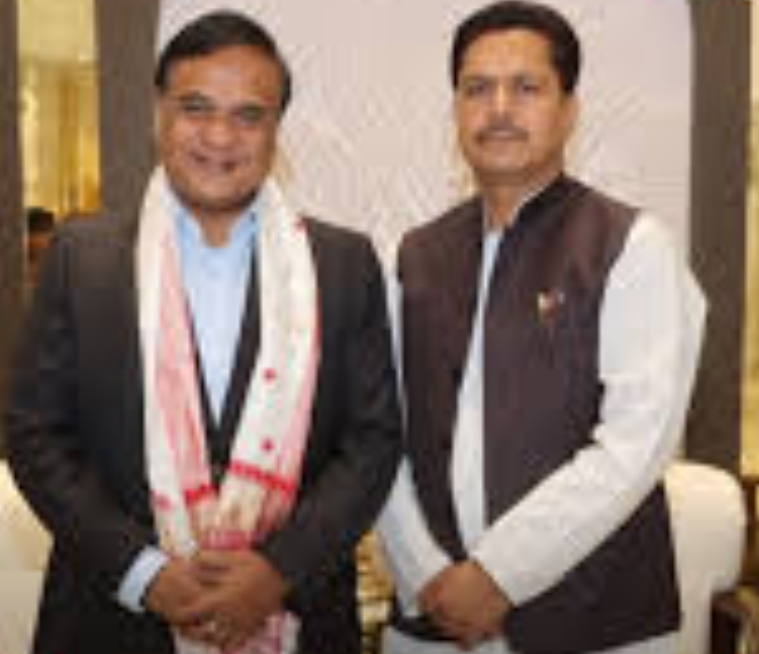
In the high-stakes theatre of Assam politics, few dramas have unfolded as dramatically as the saga of former Assam Congress president Bhupen Borah and Chief Minister Himanta Biswa Sarma. For years, Borah launched blistering attacks on Sarma—accusing him of corruption, communalism, authoritarian vendettas, and turning the state into a “debt trap.” Sarma hit back hard, branding Borah’s public gestures “vulgar,” “shameless,” and “characterless,” even directing a probe by the State Commission for Women and demanding his expulsion from Congress. Supporters on both sides lapped it up. Congress workers hailed Borah as a courageous voice against “BJP misrule.” BJP loyalists praised Sarma’s sharp rebuttals as masterful takedowns. Rumours swirled: “Sarma will jail Borah if he crosses the line.” Or, from the other camp: “Once Congress returns in 2026, Sarma will face SIT probes for corruption and land deals.”
On Sarma being a “turncoat” (this old remark resurfaced in February 2026 after Borah’s own resignation from Congress and planned move toward the BJP):
“If the people of Assam want a guarantee from my side, I am ready to swear before Maa Kamakhya and at Batadrava Than that in this lifetime, I will not change my party. However, I can challenge that the Assam Chief Minister, Himanta Biswa Sarma, cannot swear the same.” It is surprising how a so-called Hindu leader like Bhupen Borah could mock the act of swearing oaths in the names of Maa Kamakhya and the most revered Batadrava Than, which was established by the great Vaishnavite saint of Assam, Srimanta Sankardev.
The narrative was clear—two warriors locked in mortal combat. Then, in mid-February 2026, the script flipped overnight. Borah resigned from Congress on February 16, citing repeated humiliation by state unit leaders and neglect by the high command. On February 17, Sarma visited Borah’s residence, rolled out the red carpet, and announced that the former Congress chief would formally join the BJP on February 22—along with “a good number of Congress leaders.” Sarma described it as a “homecoming,” calling Borah “the last recognised Hindu leader in Congress” from a “normal family” without dynastic backing. “Congress does not give recognition to people from ordinary families,” Sarma declared, contrasting it with his own rise in the BJP.The people who had cheered the mutual mud-slinging now face an awkward question: Were we taken for granted?A Classic Case of Opportunism This is textbook politics of opportunism—where ideology takes a backseat to personal ambition and power. Borah did not switch because the BJP suddenly embraced Congress’s secular or social-justice planks; he cited internal Congress slights. Sarma did not welcome him because Borah recanted his earlier accusations of scams and communalism; the timing, just months before the 2026 Assembly polls, screams electoral arithmetic. Both leaders had built fierce personal brands on their “principled” stand against each other. Now, those brands are being quietly retired for a shared goal: survival and relevance in a polarised state.Many who believed Borah’s fiery open letters and rally speeches feel betrayed. Many who applauded Sarma’s rebuttals now watch him embrace the man he once wanted probed. The swiftness exposes how personal narratives are often weapons of convenience, not conviction. Echoes from World Political History Assam is not alone. History is littered with adversaries who became allies when interests aligned:
Lord Palmerston, British Prime Minister in the 19th century, famously said: “We have no eternal allies, and we have no perpetual enemies. Our interests are eternal and perpetual.” This realist mantra explains countless U-turns.
Alcibiades, the flamboyant Athenian general during the Peloponnesian War (5th century BC), defected from Athens to Sparta, then to Persia, and back again—each time for personal safety and power. His contemporaries called him the ultimate opportunist.
Winston Churchill switched from the Conservative Party to the Liberals in 1904 (bitterly criticising his old colleagues), then returned to the Conservatives in 1924. Critics labelled him a turncoat; he called it principle. He later formed alliances with ideological foes when Nazi Germany threatened Britain.
In 1939, bitter ideological enemies Nazi Germany and the Soviet Union signed the Molotov-Ribbentrop Pact—carving up Eastern Europe—only to become mortal enemies two years later. Interests, not ideology, dictated the dance.
Closer home in spirit: countless Indian defectors across parties have repeated the pattern, proving the proverb “Politics makes strange bedfellows” (popularised by 19th-century American writer Charles Dudley Warner).
The lesson is timeless: in politics, yesterday’s “corrupt communalist” can become tomorrow’s “respected colleague” when seats, influence, or survival are at stake. How Should the People Respond? Citizens are not powerless spectators. To counter leaders who treat ideology as disposable and narratives as changeable:
Judge by consistent actions, not rhetorical fireworks. Track a leader’s record over a decade, not a viral speech. Did Borah’s criticism of alleged scams lead to sustained legal or public pressure—or was it campaign theatre?
Demand issue-based politics. Support parties and candidates with clear, non-negotiable manifestos on core issues—flood control, employment, illegal immigration, education—rather than personality cults.
Use the ballot as the ultimate accountability tool. In 2026, reward or punish based on governance outcomes, not loyalty to individuals. Defections should not be rewarded with tickets without public explanation.
Strengthen civil society and media scrutiny. Independent watchdogs, fact-checkers, and citizen journalism can expose flip-flops in real time. Social media amplifies both opportunism and outrage—use it wisely.
Educate the next generation. Teach political history in schools: Chanakya’s ancient wisdom (“No permanent friends or enemies, only permanent interests”) alongside modern examples. An informed electorate is the best antidote to cynicism.
Reject the “lesser evil” trap. Demand better options—new parties, independents, or reformed structures—rather than accepting endless musical chairs among the same faces.
Ultimately, democracy works when voters prove they are not fools. Leaders who take people for granted eventually lose them. Impact on BJP and CongressFor Congress, Borah’s exit is a significant blow. As a two-time MLA and architect of past alliance strategies, he brought organisational muscle, especially in upper Assam. His departure—followed potentially by others—further erodes the party’s already diminished footprint (down to around 26 MLAs). It reinforces the narrative of internal chaos and “appeasement politics.” Priyanka Gandhi has downplayed it as “normal,” but morale and cadre confidence have taken a hit just months before polls.For the BJP, it is a clear gain. Sarma gains a seasoned Hindu face from a “normal family” to counter accusations of elitism or anti-Assamese bias. The induction bolsters the party’s organisational depth and sends a message: even Congress’s fiercest critics see the writing on the wall. With Assam’s 2026 polls looming, this adds momentum to the ruling alliance at a time when opposition unity is fraying. Yet neither side emerges morally superior. Both have practised the same game—Sarma himself left Congress in 2015 after bitter internal battles. The real winner or loser will be decided not in Guwahati drawing rooms, but in the voting booths of Assam.As the dust settles on February 22, when Borah formally joins the BJP, one old proverb rings truer than ever: “A week is a long time in politics.” . The people of Assam now hold the pen to rewrite the next chapter—by refusing to be taken for granted.
