

Questioning the methodology of Reporters Without Borders is legitimate, but dismissing its findings without addressing the realities confronting Indian journalism is not
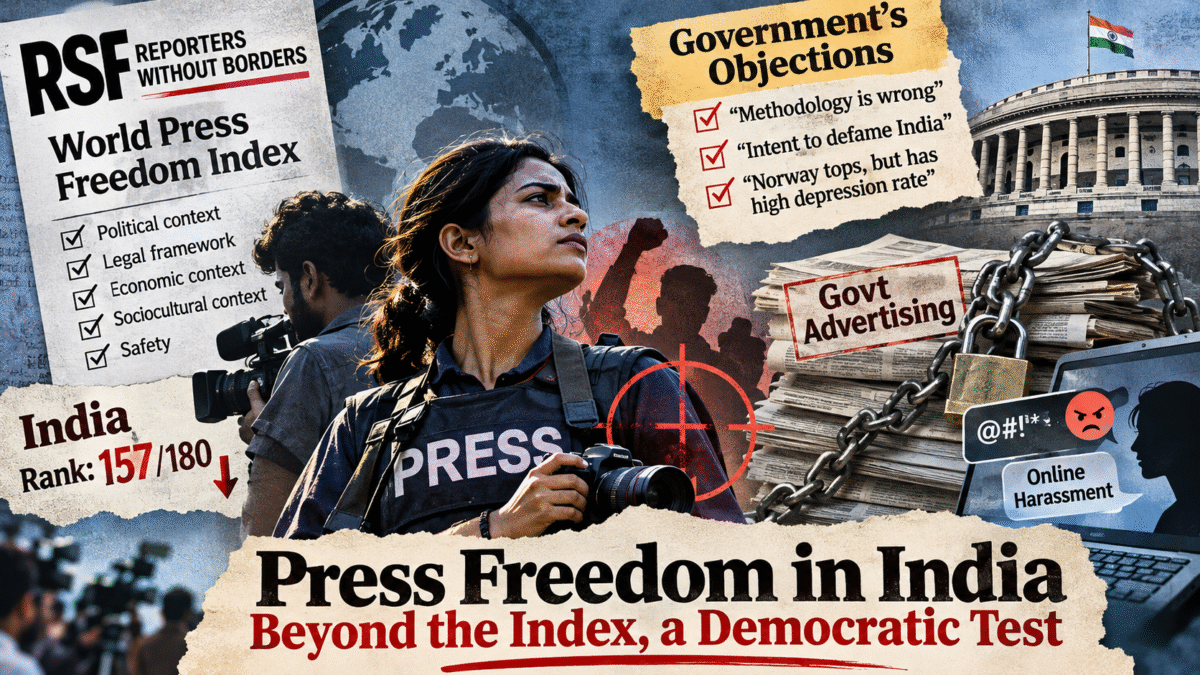
The recurring controversy over India’s position in the World Press Freedom Index published by Reporters Without Borders (RSF) reveals a deeper discomfort within the political establishment about international scrutiny of the country’s democratic credentials. Whenever India receives an unfavourable ranking, ruling party leaders, including Union ministers, question the credibility of the organisation, challenge its methodology and allege that international agencies are deliberately attempting to malign India’s image. Some even cite the ranking of Norway, which occupies the top position in press freedom assessments, alongside its supposed poor performance in mental health or depression-related rankings to suggest that international indices are inherently unreliable.
A government is perfectly entitled to question an international assessment. No index is infallible, and every methodology must remain open to academic scrutiny. But there is a fundamental difference between questioning the accuracy of a measurement and refusing to acknowledge the reality it seeks to measure. The Indian government’s response increasingly appears to confuse the two.
The World Press Freedom Index is not a referendum on the popularity of a government, nor is it an assessment of India’s economic strength, military capability or democratic size. It measures the conditions under which journalists and media organisations can function independently and without fear. The real question, therefore, is not whether India deserves a particular numerical position but whether journalists in the country enjoy the freedom and security necessary to perform their professional responsibilities.
RSF, an international non-governmental organisation dedicated to defending press freedom, assesses 180 countries and territories annually. Its methodology, substantially revised in 2022, rests on five equally weighted indicators: political context, legal framework, economic context, sociocultural context and journalist safety. The assessment combines a quantitative record of abuses against journalists and media organisations with qualitative evaluations provided by journalists, researchers, academics and other press freedom specialists through a structured questionnaire. The questionnaire is available in multiple languages, and the methodology and broad scoring framework are publicly explained.
The political indicator examines the extent of political interference, intimidation and pressure on media institutions. The legal indicator assesses constitutional and statutory safeguards, access to information and protection of journalistic sources. The economic indicator considers media ownership, financial independence, government advertising policies and commercial pressures. The sociocultural indicator examines discrimination, social hostility and pressures that restrict independent reporting. The safety indicator records physical attacks, imprisonment, threats, killings and other forms of intimidation.
Thus, the index goes considerably beyond counting incidents of violence against journalists. It attempts to examine the broader environment in which journalism operates. A journalist may never face formal censorship but may still be unable to report freely because of threats, criminal proceedings, economic retaliation or organised online harassment.
The government’s criticism of the methodology is not entirely without merit. Questions concerning the representativeness of respondents, the selection of experts and the conversion of qualitative assessments into numerical scores deserve serious consideration. NITI Aayog had also published a critical examination of the earlier RSF methodology, raising concerns about transparency and sample representation. However, that assessment preceded the substantial methodological revision introduced in 2022. Historical criticisms cannot automatically be treated as a complete evaluation of the revised framework.
More importantly, the allegation that RSF does not disclose its methodology is factually incorrect. Its indicators, broad questions, weighting system and scoring principles are publicly available. The organisation is not an international judicial authority, nor does it claim to deliver an unquestionable verdict on the democratic character of any country. Its assessment is an independent comparative instrument, open to criticism and scrutiny. But disagreement with its findings cannot, by itself, establish political conspiracy or deliberate hostility towards India.
The argument involving Norway and depression rankings is equally unconvincing. Norway’s leading position in press freedom reflects its institutional safeguards, independent media environment, legal protections and professional security for journalists. Mental health indicators measure an entirely different phenomenon, influenced by diagnostic practices, awareness, healthcare access and reporting standards. A country can perform exceptionally well in protecting press freedom while facing significant mental health challenges. There is no contradiction. Comparing unrelated indices to discredit an assessment is not a serious methodological argument.
The more important issue is what India’s ranking tells us about the environment confronting journalism. India stood at 151st position in the 2025 RSF index and slipped to 157th among 180 countries in the 2026 assessment. Whether one agrees with the precise position or not, the deterioration should prompt an examination of the conditions responsible for it.
The problems are neither imaginary nor confined to the observations of international organisations. Journalists reporting on corruption, environmental destruction, illegal mining, communal violence, administrative failures and political misconduct have faced threats, physical attacks, criminal cases and intimidation. The safety of journalists, particularly those working outside major metropolitan centres, remains a serious concern. The absence of a comprehensive national database makes the problem even more difficult to assess.
Online harassment has emerged as another particularly disturbing threat. Women journalists who question political authority, investigate controversial developments or challenge communal narratives are frequently subjected to misogynistic abuse, threats of sexual violence, character assassination and coordinated campaigns of intimidation. Such attacks are not merely offensive exchanges on social media. They are increasingly used to discourage women from participating in public debate and pursuing independent journalism. A democracy cannot claim to protect freedom of expression while allowing women journalists to be threatened into silence.
Economic pressure is equally significant. Government advertisements are financed by taxpayers and should serve the purpose of public information, not political patronage. Yet smaller and independent newspapers have repeatedly complained about discriminatory allocation or withdrawal of government advertisements. When publications critical of government policies face economic disadvantages while favourable publications receive preferential treatment, advertising becomes an instrument of influence rather than public communication.
This is particularly damaging to regional-language and small and medium newspapers, which often depend substantially on government advertising for survival. Editorial independence cannot exist where the financial survival of a publication depends on pleasing the political establishment. The RSF methodology specifically recognises discriminatory government advertising and economic pressure as important components of press freedom.
The concentration of media ownership and growing corporate influence also raise questions about genuine pluralism. The existence of hundreds of television channels and thousands of publications does not necessarily guarantee diversity of opinion. Media plurality must be judged by whether different perspectives can reach the public independently of political and commercial pressure.
The use of criminal proceedings and restrictive legal provisions against journalists can produce an equally damaging chilling effect. Even when a journalist is eventually acquitted, prolonged investigations, detention, financial hardship and reputational damage can discourage further investigative reporting. National security and public order are legitimate concerns, but they cannot become convenient grounds for suppressing legitimate journalism. Article 19(1)(a) of the Constitution guarantees freedom of speech and expression, subject to the reasonable restrictions under Article 19(2). These constitutional protections must have practical meaning for journalists as well as other citizens.
The government should also recognise a serious institutional deficiency: India does not maintain a sufficiently comprehensive and transparent national record of attacks against journalists. In a parliamentary response in 2022, the Information and Broadcasting Ministry stated that the National Crime Records Bureau did not maintain separate data on attacks against journalists. It is difficult to dismiss international assessments of journalist safety while the country itself lacks an adequate system for documenting the problem.
The way forward should therefore be institutional reform rather than political confrontation with international organisations.
India needs an independent national mechanism for monitoring attacks on journalists, recording threats, physical violence, arbitrary detention and killings, and publishing the progress of police investigations and prosecutions. A comprehensive Journalist Safety and Protection Law should provide for time-bound investigations, legal assistance, protection against intimidation and special safeguards for women journalists. The Press Council of India should be strengthened to undertake systematic monitoring of press freedom, including the economic vulnerability of smaller publications and the challenges faced by digital journalists.
Equally important is the need for transparent government advertising guidelines. Allocation must be based on objective and verifiable criteria such as circulation, readership, regional reach, publication regularity and language diversity. No newspaper should be denied government advertisements because of its editorial position. An independent grievance-redressal mechanism should examine complaints of discriminatory treatment.
The government must also establish effective mechanisms to address online threats, doxing and gender-based harassment of journalists. Media ownership and cross-media concentration require greater transparency to protect editorial independence and diversity of opinion.
India should engage constructively with RSF, UNESCO, the International Federation of Journalists and other professional organisations. It should seek detailed explanations of its indicator-wise scores, present verifiable evidence of improvements and shortcomings, and participate in discussions to strengthen international assessment methods. Such engagement would demonstrate confidence in India’s democratic institutions rather than insecurity about international criticism.
Ultimately, the freedom of the press is not an issue belonging to the ruling party or the Opposition. A journalist exposing corruption in a BJP-governed state performs the same democratic function as one exposing corruption under a Congress or regional-party government. Protection of journalism must transcend political affiliations.
India aspires to become a global leader and frequently invokes its democratic heritage and constitutional values. It cannot simultaneously demand international recognition of its democratic credentials while treating unfavourable scrutiny as an act of hostility. A confident democracy should welcome criticism, examine uncomfortable evidence and correct institutional weaknesses.
The real issue is not whether India ranks 151st, 157th or any other position in an international index. It is whether a journalist can investigate corruption involving a powerful minister, expose the wrongdoing of an influential businessman or question a government policy without fearing arrest, physical assault, loss of livelihood or organised online intimidation.
Until that question can be answered convincingly, dismissing the RSF index as an international conspiracy will remain an inadequate response. A free press is not the enemy of a government. It is one of the strongest safeguards against the abuse of governmental power. The strength of a democracy is not demonstrated by how effectively its leaders defend the country’s international ranking, but by how effectively its institutions defend the freedom of those who question them.
