

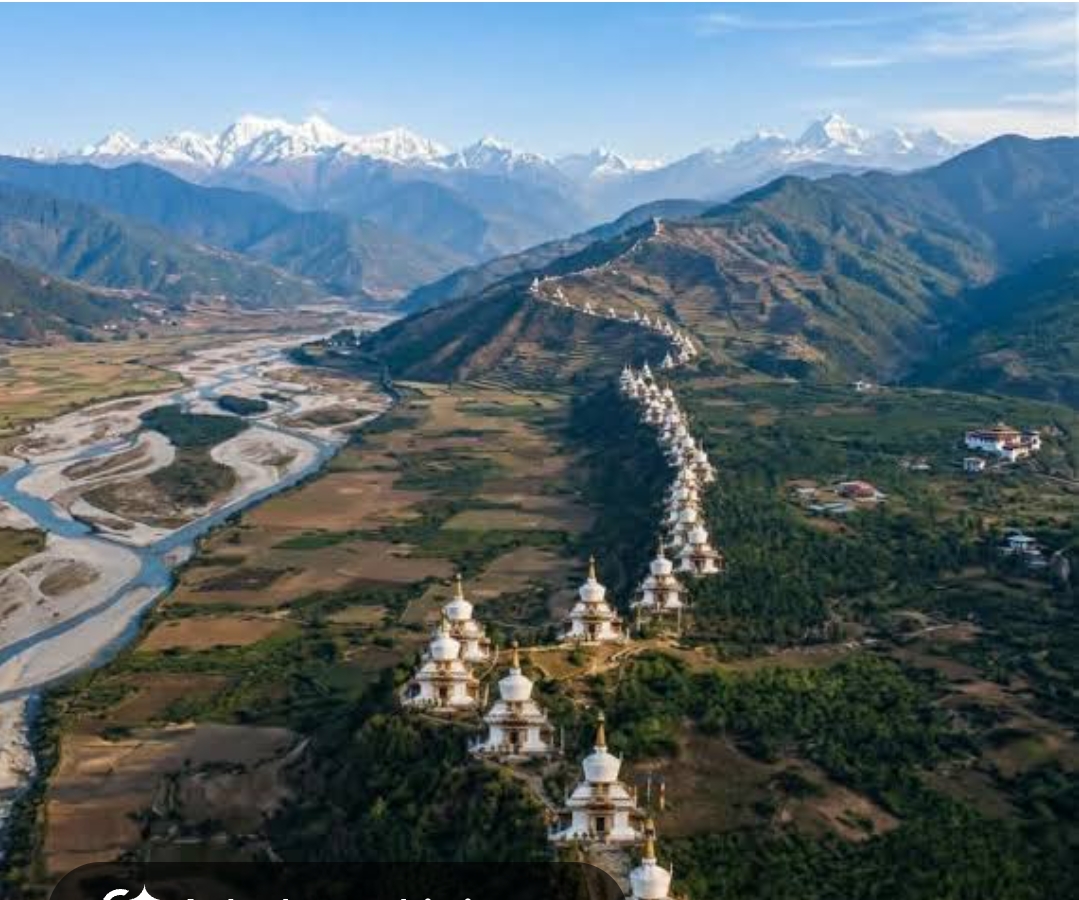
Mindfulness City offers a historic opportunity to unite spiritual heritage, sustainable tourism and cross-border economic cooperation—but Bhutan must also make its doors more accessible to Indian visitors.
The consecration of 108 Buddhist stupas at Gelephu on November 1, 2026, is more than a religious ceremony. It is an expression of Bhutan’s determination to preserve its spiritual heritage while preparing for a new phase of economic and urban development. For Assam and India’s Northeast, which share a long geographical, historical and cultural relationship with Bhutan, the event presents an opportunity to rethink cross-border cooperation.
The 108 Jangchub Chortens, each approximately 15 metres tall, are being raised as part of a collective religious undertaking. In Buddhist tradition, the stupa represents the path towards enlightenment, wisdom, compassion and liberation from suffering. The number 108 has deep spiritual significance in Buddhist traditions and is associated with prayer, meditation and spiritual practice.
At a time when the world is troubled by wars, violence, intolerance and growing social divisions, the message of peace embodied in these stupas has significance beyond Bhutan’s borders. Their construction also reflects the country’s effort to demonstrate that modern development need not require abandoning cultural identity and spiritual values.
But the larger question is whether this historic occasion can become the starting point for a new partnership between Bhutan and neighbouring India, particularly Assam and the Northeast.
Understanding the idea of Mindfulness City
Gelephu Mindfulness City (GMC) is among the most ambitious development initiatives in Bhutan’s recent history. Envisioned by King Jigme Khesar Namgyel Wangchuck and formally established under a Royal Charter in February 2024, it is designed as a highly autonomous Special Administrative Region in southern Bhutan, adjoining Assam.
The official vision is to build an economic hub that combines investment, innovation, technology and modern infrastructure with Bhutanese spiritual traditions, environmental sustainability and the philosophy of Gross National Happiness. The project is intended to explore an alternative model of development in which economic prosperity is not the sole measure of progress.
The word mindfulness is therefore important. It refers to conscious attention, reflection and awareness of one’s actions and their consequences. Applied to urban development, it suggests a city that seeks to balance material prosperity with mental well-being, social harmony and respect for nature.
This is an attractive ambition in an era when many cities struggle with pollution, congestion, excessive consumption and widening inequality. Yet the real test will lie in implementation. A city described as mindful must demonstrate environmental responsibility, equitable opportunities, transparent governance and respect for local communities. Its success cannot be measured simply by the scale of investment, the height of buildings or the number of international companies it attracts.
Assam must not remain merely a neighbour
Gelephu’s geographical proximity to Assam gives India a particularly important role in its development. The town is connected to the broader economic landscape of the Northeast, where agriculture, tourism, transport, energy and small industries offer substantial opportunities for cooperation.
India and Bhutan already have a strong economic relationship. According to the Indian government’s November 2025 bilateral brief, bilateral trade reached approximately ₹12,669 crore in 2024, with India accounting for nearly 80 per cent of Bhutan’s total trade. Both countries have also been expanding cooperation in energy, infrastructure and connectivity.
The next phase should extend beyond conventional trade and hydropower projects.
Assamese farmers and producers could explore opportunities to supply fresh vegetables, rice, fruits, spices, processed food and other agricultural products to the growing Gelephu market. Local entrepreneurs could develop logistics services, transport facilities, hospitality businesses and cultural tourism packages. Small enterprises in handicrafts, bamboo products, textiles and traditional food could also benefit from a larger cross-border market.
However, these opportunities will not materialise automatically. They require transparent trading arrangements, reliable transport, simplified customs procedures, predictable regulations and access to market information for small businesses.
The proposed railway connection between Kokrajhar in Assam and Gelephu is particularly significant. Under the bilateral agreement signed in September 2025, the planned rail links include the 69-kilometre Kokrajhar–Gelephu route and the 20-kilometre Banarhat–Samtse route, with an estimated combined project cost of ₹4,033.34 crore.
Once developed, such links could strengthen passenger movement, trade and tourism. But the railways must be accompanied by efficient road connections, suitable border facilities and arrangements that allow local traders and smaller tourism operators to participate.
The benefits of Gelephu’s growth should reach the communities on both sides of the border rather than remain concentrated among a handful of large investors.
A shared Buddhist and cultural heritage
The relationship between Assam and Bhutan is not merely commercial. It is rooted in geography, cultural exchange, traditional practices and centuries of contact across the eastern Himalayan region.
Buddhism offers an important foundation for closer people-to-people ties. The stupas at Gelephu could become a focal point for Buddhist pilgrims, scholars, researchers and cultural travellers from India and abroad. Assam, with its own rich religious and cultural traditions, could be included in wider itineraries connecting Buddhist heritage, historical sites, monasteries, traditional settlements and the natural landscapes of the Northeast.
Such cooperation should not be confined to religious tourism. Universities, cultural institutions and civil society organisations could organise exchanges on Buddhist philosophy, traditional medicine, architecture, conservation, indigenous knowledge and environmental protection.
Festivals, food, music, crafts and folk traditions could be promoted through joint cultural events. Educational exchanges could enable young people from Assam and Bhutan to learn about one another’s histories and societies.
The objective should be to develop a relationship in which the border acts as a meeting point rather than a barrier.
Will tourism grow?
The potential is considerable. The 108-stupa ceremony itself is expected to draw large numbers of participants and visitors. The development of Gelephu Mindfulness City, improved connectivity and the growth of accommodation and other facilities could create additional reasons to visit the region.
But tourism growth will depend on more than the attraction of a major religious event. Visitors need convenient transport, clear information, affordable accommodation, accessible entry procedures and a range of experiences beyond a single destination.
Gelephu could develop into a centre for spiritual retreats, meditation, wellness tourism, nature-based travel and cultural exploration. Its location could also help create circuits linking Assam’s wildlife destinations, wetlands, forests and cultural attractions with Bhutan’s landscapes and heritage.
Tourism operators on both sides should jointly develop packages, provide reliable booking information and make cross-border travel easier for families, senior citizens, independent travellers and budget-conscious visitors.
The challenge is to avoid a situation in which the destination attracts international attention but ordinary visitors find it too expensive or complicated to explore.
Tourism fees and the need for a more welcoming approach
One of the concerns among Indian travellers has been the cost and complexity of visiting Bhutan. The Sustainable Development Fee, guide requirements and additional vehicle charges can make travel more expensive, particularly for families and visitors who prefer independent, short-duration trips.
Under Bhutan’s published rules, Indian nationals generally pay an SDF of ₹1,200 per person per night. A guide is required for visitors travelling beyond designated border towns, while Indian-registered vehicles travelling beyond specified zones can face additional green-tax requirements. However, the rules are not uniform for every type of visit.
A significant exception has already been introduced. Since June 2, 2026, Indian tourists visiting Gelephu, Phuentsholing, Samtse and Samdrup Jongkhar for up to 24 hours have been exempt from the SDF within designated border-town zones under a temporary arrangement. The waiver is scheduled to continue until August 2027, subject to the applicable conditions.
This is a welcome opening, but the wider policy deserves reconsideration.
Bhutan has legitimate reasons to regulate tourism. Its fragile environment, limited infrastructure and cultural heritage require protection from uncontrolled mass tourism. The SDF is intended to support sustainable development, while guide requirements can help ensure safety and responsible travel.
Nevertheless, conservation and accessibility need not be opposing objectives. If fees and mandatory arrangements discourage ordinary Indian families, students, pilgrims and budget travellers, Bhutan risks losing an important source of goodwill and cultural exchange.
A more flexible system could distinguish between short visits to border towns, religious pilgrimages, educational groups, longer holidays and specialised trekking. Affordable guide services, transparent pricing and simpler digital permits could make travel more accessible without abandoning environmental safeguards.
Bhutan and India could also examine special arrangements for educational exchanges, cultural delegations and organised pilgrimage groups. Longer-term, the two countries could explore reciprocal tourism facilitation and joint promotion of regional destinations.
The guiding principle should be simple: responsible tourism must protect Bhutan’s environment while allowing more people to experience its culture and hospitality.
The way forward
The November 1 ceremony should be treated as a beginning, not an isolated spectacle.
First, India and Bhutan should establish a practical framework for Gelephu–Assam economic cooperation, bringing together government agencies, chambers of commerce, tourism associations, farmers and local entrepreneurs.
Second, the proposed rail connection and improvements to border infrastructure should be accompanied by simpler passenger procedures, efficient customs facilities and reliable public transport. The opening of the Darranga immigration check post in Assam in November 2024 and the subsequent bilateral initiatives provide a foundation for this work.
Third, tourism authorities should jointly develop cross-border cultural and ecological circuits. Local communities should receive training and support to operate homestays, guide services, food businesses and craft enterprises. A fair share of tourism revenue must reach the people whose landscapes and traditions attract visitors.
Fourth, the Mindfulness City project should uphold its stated environmental ambitions through careful land-use planning, water conservation, protection of biodiversity and meaningful consultation with affected communities. Rapid construction must not come at the expense of the natural environment or the social fabric of the region.
Finally, both governments should encourage sustained exchanges between universities, cultural organisations, journalists, young people and community groups. Durable friendship grows through everyday contact, not only through official agreements and ceremonial occasions.
Beyond the stupas
The 108 Buddhist stupas at Gelephu symbolise peace, wisdom and collective endeavour. Their deeper significance will depend on whether these values can inform the development taking place around them.
Bhutan’s ambition to create a Mindfulness City offers an opportunity to rethink the relationship between economic growth, cultural continuity and human well-being. For Assam and India’s Northeast, it opens the possibility of stronger trade, better connectivity, expanded tourism and a closer cultural partnership with a neighbouring country.
But infrastructure alone cannot build lasting friendship, and investment figures cannot fully measure regional prosperity. The real achievement would be a development model in which businesses flourish, visitors are welcomed, nature is protected and communities on both sides of the border share the benefits.
If Bhutan can combine its spiritual heritage with an accessible and inclusive approach to tourism, and if India can match that vision with effective connectivity and genuine local participation, Gelephu could become more than a new economic centre.
It could become a bridge between the traditions of the eastern Himalayas and the opportunities of a changing South Asia—a place where prosperity is measured not only in wealth, but also in peace, dignity, cultural understanding and shared well-being.
