

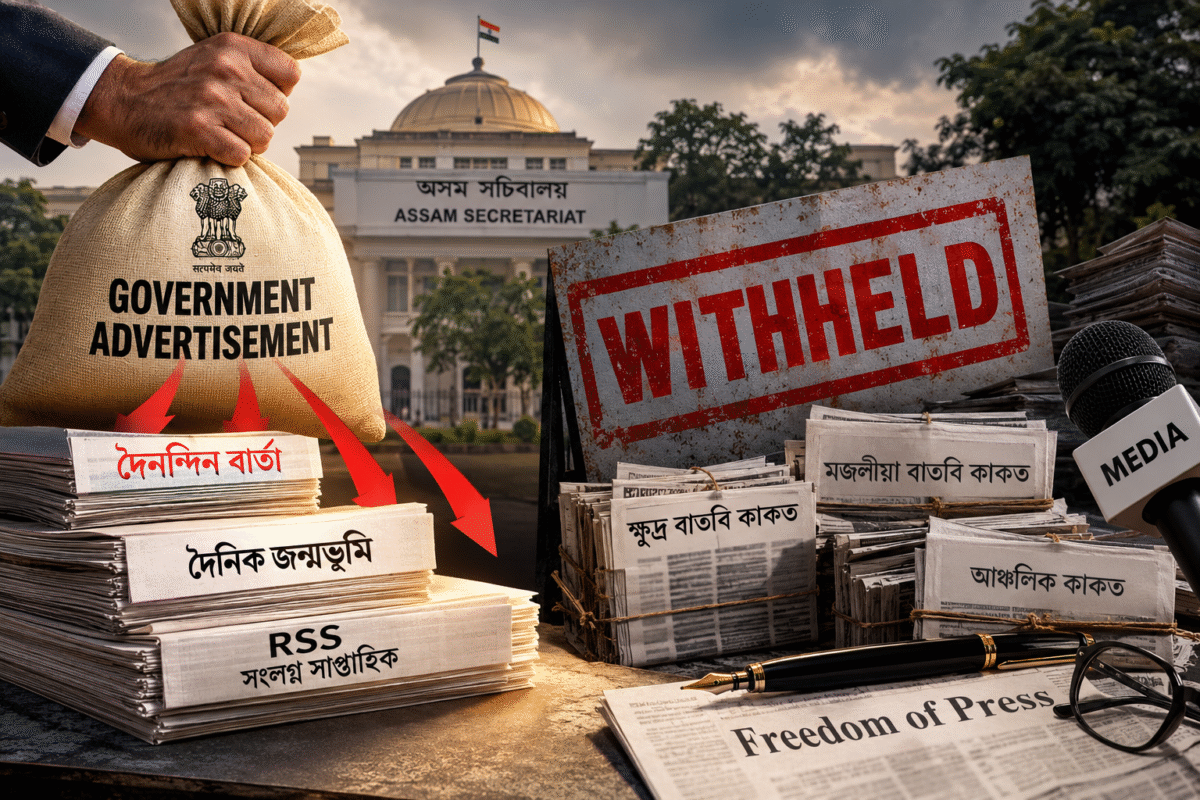
Assam’s continued withholding of advertisements from small and medium newspapers raises serious questions about equality, press freedom and the rule of law
The freedom of the press is meaningful only when newspapers can function without fear of political retaliation or economic coercion. A government may disagree with a newspaper’s editorial position, resent its criticism or challenge its reporting. But it cannot legitimately use its financial power to reward favourable coverage and punish publications that question its policies. Government advertising, funded by public money, must serve the public interest, not the political interests of the government of the day.
The continuing non-issuance of government advertisements to most small and medium newspapers in Assam, reportedly beginning on March 15, 2026, during the Model Code of Conduct for the Assembly elections, raises precisely this concern. The Model Code of Conduct ended on May 5, 2026, but, according to representatives of the affected newspapers, advertisements have not been restored to most of them. If this situation continues without a lawful, transparent and uniformly applicable explanation, the Assam Government must answer a fundamental question: on what grounds are eligible newspapers being denied a facility that is essential to their survival?
The issue is not whether every newspaper has an automatic right to receive every government advertisement. No such unconditional entitlement exists. The issue is whether the government can arbitrarily withhold advertisements from eligible publications while distributing public advertising expenditure without transparent, objective and non-discriminatory criteria. The distinction is crucial.
A policy that must apply to everyone
The Government of Assam has its own advertisement policy governing the release of advertisements through the Directorate of Information and Public Relations (DIPR). The department’s official website identifies DIPR as the agency responsible for releasing government advertisements to the media. The government also maintains a list of recognised newspapers and periodicals. These arrangements presuppose that advertising decisions must be made within an established administrative framework rather than according to the unstructured discretion of individual officials.
The Press Council of India’s Model Advertisement Policy provides an unambiguous statement of the principles involved. It says:
“Governmental authorities should not single out a newspaper for discriminatory treatment in the matter of release of advertisements on account of its critical writings.”
It further states that the release of advertisements should not be undertaken on an ad hoc basis but should follow a notified policy founded on rational criteria. Political considerations, it emphasises, should not determine the decision. The policy also recognises that smaller newspapers dependent on government advertising revenue require special consideration.
These principles are not merely administrative niceties. They address a fundamental danger inherent in the relationship between the state and the media. When the government controls a significant source of revenue for newspapers, arbitrary allocation can become a means of exerting pressure without imposing a formal ban or directly censoring a publication.
The Press Council has also made an important distinction: although newspapers cannot claim advertisements as a matter of right, government advertising is not a grant to be distributed at the whim of the controlling authority. Discretion must operate within rational and fair limits.
The Assam Government cannot reasonably insist that small newspapers comply with eligibility requirements, circulation criteria and other policy conditions while itself avoiding transparent explanations for the continued withholding of advertisements.
The constitutional question
The Constitution guarantees equality before the law under Article 14 and freedom of speech and expression under Article 19(1)(a). Freedom of the press, although not separately enumerated as an independent fundamental right, is protected within the constitutional guarantee of freedom of speech and expression.
The relationship between government advertising and press freedom has already received judicial consideration.
In Common Cause v. Union of India, decided on May 13, 2015, the Supreme Court examined the regulation of government advertisements and approved guidelines intended to prevent misuse of public funds and politically motivated advertising. The Court underscored that government advertising must serve legitimate public-information purposes and that fairness and equitable treatment of media and publishing houses must be maintained by governments at both the Centre and the state level.
The Court observed that “the concepts of fairness and even dispensation to all media/publishing houses will have to be maintained by the Government be it at the Centre or the States.”
The judgment addressed the principles governing government advertising rather than establishing an unconditional right to an equal monetary allocation for every newspaper. Nevertheless, its central message is relevant: public money cannot be administered in a manner that permits arbitrary patronage or undermines the impartiality expected of government.
The issue has particular significance in Assam because the Gauhati High Court, in State of Assam & Others v. Omega Printers and Publishers Pvt. Ltd., considered discriminatory allocation of government advertisements. The court observed that discriminatory allotment of advertisements to newspapers of the same category could impair press freedom and violate Articles 14 and 19(1)(a) of the Constitution.
The precise application of these principles depends on the facts, the policy in force and the evidence of differential treatment. But they establish why the present allegations deserve serious scrutiny rather than dismissal as a dispute over commercial revenue.
The Model Code of Conduct cannot be an indefinite excuse
The reported chronology makes the matter more troubling. The withholding of advertisements is said to have begun on March 15, 2026, when the Model Code of Conduct came into operation in connection with the Assembly elections. Such a restriction, where applicable, must be understood in the context of election rules and the need to prevent the misuse of official resources.
But an election-related restriction cannot, by itself, explain an indefinite suspension of advertising after the relevant code has ceased to operate. The government must clarify whether any subsequent order, financial decision, eligibility review or other lawful administrative reason has prevented advertisements from being restored.
If advertisements remain withheld from eligible newspapers after May 5 without a reasoned explanation, the government owes the affected publications and the public a clear account of its decision. It must disclose the applicable instructions, the criteria being followed and the reasons for continuing the suspension.
A temporary restriction associated with elections must not become a convenient pretext for prolonged economic exclusion.
Selective patronage demands transparency
There are also concerns among sections of the newspaper industry that certain publications continue to receive substantial government advertisements while numerous small and medium newspapers remain deprived of them. Questions have been raised about the distribution of advertisements to publications such as Dainandin Barta and Dainik Janambhumi, among others.
These concerns should be tested against official records, not settled through allegation alone. The government should publish newspaper-wise figures showing the number, frequency and monetary value of advertisements released during the relevant period, along with the circulation categories, eligibility conditions and criteria used to select publications.
Such disclosure would establish whether similarly situated newspapers have been treated differently and, if so, whether any legitimate policy consideration explains the difference. Circulation, geographical reach, language, target readership and the purpose of a particular campaign may all be relevant. But these considerations must be applied consistently and transparently.
If the records demonstrate that eligible newspapers have been excluded without objective justification while others have enjoyed preferential treatment, the government will have to explain that disparity. If no such disparity exists, publication of the data would help dispel suspicion. Transparency serves the public interest in either case.
Small newspapers cannot be sacrificed
The economic consequences of prolonged advertising exclusion can be severe. Large media houses may have several revenue streams, substantial reserves and diversified business operations. Small and medium newspapers, especially those serving regional and linguistic communities, often operate on narrow financial margins.
Government advertisements help meet printing, distribution, staff and other operating expenses. Their prolonged absence can threaten regular publication, reduce the capacity to employ journalists and weaken reporting from districts and rural areas.
The consequences extend beyond newspaper proprietors. Readers lose access to diverse sources of information. Local grievances may receive less attention. Communities whose concerns are rarely covered by larger publications may find their voices further marginalised.
This is why the Press Council’s Model Advertisement Policy specifically recognises the vulnerability of smaller newspapers. A formally neutral decision can also have unequal consequences if it ignores the particular dependence of these publications on public advertising revenue. That does not mean that every small newspaper must receive advertisements regardless of eligibility or public need; it means that a fair policy must be administered consistently and with due regard to its stated objectives.
Public money must not purchase editorial silence
The government has a legitimate responsibility to inform citizens about welfare schemes, recruitment, public-health advisories, tenders, public notices and other matters of public importance. Government advertisements are therefore a necessary instrument of public communication.
But their purpose is to communicate information, not to create a system of political patronage. The state must not use advertising expenditure to cultivate favourable reporting or discourage critical journalism. Nor should a newspaper have to choose between financial survival and its responsibility to scrutinise those in power.
A free press is not one that merely publishes without a formal censor. It must also be able to investigate, question and criticise the government without reasonably fearing that its livelihood will be threatened through arbitrary administrative decisions.
There is no need to establish an explicit threat for the danger to become apparent. Where the allocation of an important revenue source is opaque, unexplained disparities can themselves create uncertainty and a chilling effect. Whether that has occurred in Assam is a matter that should be examined through documentary evidence and an independent assessment.
Restore advertisements under the declared policy
The Assam Government should immediately review the continued non-issuance of advertisements to eligible small and medium newspapers and restore their consideration under the declared advertisement policy. It should publish the applicable criteria, disclose the relevant newspaper-wise expenditure and provide written reasons wherever an eligible publication has been excluded or its advertisements substantially reduced.
The government must also clarify the administrative basis for continuing the suspension after the Model Code of Conduct ended on May 5. Any genuine financial, regulatory or eligibility-related restriction should be supported by a transparent decision and applied uniformly to similarly situated publications.
The Press Council of India should examine the complaint raised by representatives of small and medium newspapers, seek the relevant records from the Assam Government and assess whether the policy has been applied in a discriminatory manner. Where the evidence establishes arbitrary treatment affecting press freedom, the Council should make appropriate recommendations within its statutory powers.
The demand is not for special favour. It is for the faithful implementation of declared policy, equal treatment under the law and protection against the use of public resources as an instrument of editorial pressure.
The government may have the power to decide where and how public information is disseminated, subject to law and policy. It does not have a legitimate licence to distribute public advertising according to political convenience. The test of a democratic administration is not whether newspapers praise it, but whether it respects the rights of those that question it.
The Assam Government must act without further delay. Restore government advertisements to eligible small and medium newspapers in accordance with the declared policy, explain the prolonged suspension, and ensure that public money is allocated through transparent, rational and non-discriminatory procedures. The freedom of the press cannot be protected by constitutional promises alone; it also requires an administration that refuses to use economic power to silence inconvenient voices.
