

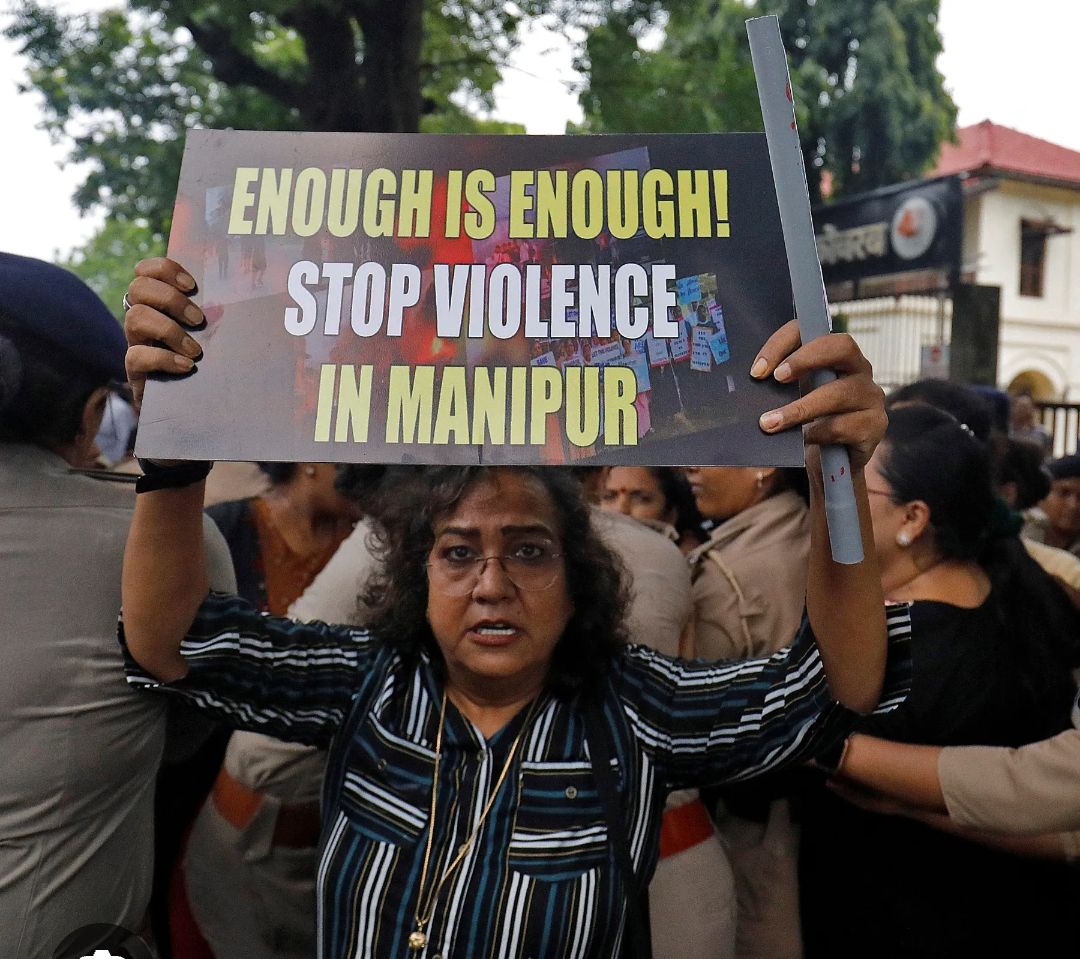
Manipur has entered a crucial phase in its long and painful journey out of the ethnic conflict that erupted in May 2023. More than three years after the violence began, the immediate intensity of the conflict has declined in several areas, an elected government has returned, roads and institutions are gradually reopening, and thousands of displaced people have begun returning to their homes. Yet these developments should not be mistaken for the restoration of normality. The deeper crisis remains unresolved: communities continue to live with fear, separation, competing political demands, damaged livelihoods and a profound deficit of trust.
The central challenge before Manipur today is therefore not merely to end violence. It is to rebuild the conditions under which people belonging to different communities can once again live, travel, trade, study and work without seeing one another primarily through the prism of conflict.
The recent editorial in The Indian Express, “Ensure dignity, way back for Manipur’s displaced”, rightly draws attention to a fundamental principle: rehabilitation cannot simply mean moving displaced families from relief camps back to their former locations. A house alone cannot restore a life destroyed by conflict. Displaced families need security, livelihoods, education, healthcare and social acceptance before they can genuinely rebuild their lives.
The unfinished humanitarian crisis
The scale of displacement remains enormous. According to figures placed before the Manipur Assembly in September 2026, about 60,000 people were displaced by the violence. The state government has said that around 24,000 people were still living in relief camps, while thousands more had returned or been resettled elsewhere. The government has also reported the construction of thousands of houses for displaced families.
Another state Home Department report, cited by The Sangai Express, put the number of internally displaced people still staying in relief camps and temporary locations at 28,899 as of September 3, while reporting that 31,823 had returned to their own houses. It also said that 7,034 houses had been constructed and 4,159 repaired.
These figures demonstrate both progress and the enormity of the remaining task.
A particularly important distinction must be made between physical resettlement and meaningful rehabilitation. A family may be given a newly constructed house, but if its agricultural land cannot be cultivated, its children cannot safely attend school, healthcare is inaccessible and the surrounding community remains divided, the family has not truly returned to normal life.
This is why rehabilitation requires a comprehensive approach. Housing must be accompanied by livelihood assistance, restoration of agricultural and commercial activities, educational support, healthcare, psychological assistance and reconstruction of community infrastructure.
Security is necessary, but not sufficient
Security remains the foundation of any return. No displaced family can reasonably be expected to return to an area where it fears renewed attacks.
The Manipur government has acknowledged that the trust deficit created by the violence remains one of the principal obstacles to resolving the crisis. Chief Minister Yumnam Khemchand Singh told the Assembly in September that distrust between communities had become so deep that, during the early period of the conflict, even community leaders were reluctant to communicate with one another.
This is an important observation because it shows that the crisis cannot be solved exclusively through policing or military deployment. Security forces can prevent attacks, recover weapons and protect vulnerable locations. They cannot, by themselves, rebuild relationships between neighbours who have been separated by years of violence.
The state therefore needs a dual strategy: effective security against armed violence alongside sustained political and social dialogue.
The objective should not be to impose an artificial appearance of peace. It should be to create conditions in which peace becomes sustainable.
The question of justice
Another essential component is accountability.
According to the state Home Minister’s statement in the Assembly, 3,020 FIRs had been registered in connection with 9,647 incidents of violence, with 312 chargesheets filed. Twenty-nine cases were being investigated by the National Investigation Agency and 32 had been handed over to the Central Bureau of Investigation.
The credibility of this process will matter enormously.
For victims, justice cannot mean merely the registration of cases. It means impartial investigation, prosecution where evidence supports it, protection of witnesses and timely judicial proceedings. Justice must also be visibly even-handed. If one community believes that crimes against it are ignored while another is treated more seriously, the judicial process itself can become another source of mistrust.
The recent intervention of the Supreme Court illustrates why humanitarian accountability cannot be separated from rehabilitation. On September 17, 2026, the Court sought a comprehensive report from the Manipur government regarding 25 unnatural deaths of internally displaced persons in relief camps, including a case involving alleged sexual assault, and asked for details concerning FIRs and camp conditions.
The message is significant: people living in relief camps are not merely beneficiaries of government assistance. They remain citizens entitled to dignity, safety and legal protection.
Return must be voluntary and secure
There should be no pressure—direct or indirect—on displaced people to return simply because the government wants to close relief camps.
The decision to return must be based on informed consent and genuine security. Families should know what protection will be available, whether their houses have been reconstructed, whether schools and healthcare facilities are functioning, and whether they can resume their livelihoods.
This is particularly important in areas where communities have become geographically separated during the conflict.
The government itself has recognised the importance of rebuilding trust. In September, the Chief Minister said that the administration was attempting to bridge the trust deficit and cited the participation of Kuki-Zo legislators in the Assembly as one indication of increased interaction. He also referred to efforts to reopen important roads and improve communication between communities.
Such initiatives need to be expanded beyond political institutions into everyday life.
A dialogue that includes everyone
A durable settlement cannot be negotiated only between governments and political organisations. Civil society, women’s organisations, youth groups, tribal bodies, community leaders, religious organisations, displaced persons and other stakeholders must have a place in the process.
The objective should not initially be to force agreement on every contentious political question. Some issues may require prolonged negotiation. The first task should be to identify areas where practical cooperation is possible.
Opening roads, restoring markets, ensuring access to hospitals and schools, facilitating agricultural activity and enabling safe movement can create small but important spaces for interaction.
The experience of Jiribam offers one such example. The Chief Minister has pointed to occasions when Meitei, Kuki, Paite and Hmar communities were able to come together peacefully. The government has expressed the hope that such local examples can be replicated elsewhere.
Peace often begins not with a grand political settlement but with ordinary people discovering that cooperation is possible.
Rehabilitation must include the economy
Conflict has also devastated Manipur’s economy. Businesses have suffered, agricultural activity has been disrupted, transportation routes have been affected and families have lost sources of income.
Consequently, rehabilitation packages must extend beyond houses.
Displaced farmers need seeds, tools, livestock and access to their fields. Small traders need credit and market access. Young people need vocational training and employment opportunities. Children who lost years of schooling require special educational support.
The state budget has already provided substantial resources for housing, repair of damaged houses and community assets. The government’s 2026-27 budget, for instance, provided ₹734 crore for IDP rehabilitation, while central assistance has also been allocated for housing and damaged assets.
The next question is implementation and transparency. Every rupee allocated for rehabilitation should reach its intended beneficiaries. Independent monitoring, public disclosure of expenditure and community participation can reduce mistrust and improve accountability.
Restoring trust is the real test
Manipur’s crisis has demonstrated that peace imposed from above is fragile. A durable peace has to be accepted from below.
That means acknowledging the suffering of all communities without creating a hierarchy of victims. The killing of a Meitei, Kuki-Zo, Naga or member of any other community must evoke the same concern for human life. Similarly, displacement, destruction of homes, sexual violence, abductions and attacks on religious or cultural sites cannot be justified by the identity of either the victim or perpetrator.
The temptation to reduce Manipur’s crisis to a simple contest between two communities should also be resisted. Manipur’s social and political landscape is more complex, with Meitei, Kuki-Zo, Naga and other communities possessing distinct histories, territorial concerns and political aspirations.
A sustainable settlement will therefore require sensitivity to this diversity rather than an insistence that one uniform solution can resolve every grievance.
A roadmap for the future
The way forward should rest on several interconnected pillars: security, justice, dignified rehabilitation, livelihood restoration, political dialogue and reconciliation.
The government should publish a clear, time-bound rehabilitation roadmap showing how many displaced families remain, where they are located, what housing and livelihood assistance they require and when each stage will be completed. Local communities should participate in implementation, while independent institutions should monitor progress.
At the same time, dialogue between communities must continue even when agreement on larger political questions remains elusive. Confidence-building measures—safe roads, reopening of markets, educational cooperation, cultural exchanges and regular communication between community representatives—can gradually reduce isolation.
Finally, Manipur needs an honest acknowledgement that rebuilding will take time. Three years of violence cannot be undone in a few months.
The real measure of recovery will not be the number of houses constructed or relief camps closed. It will be whether a displaced family can return home without fear, whether a child can attend school alongside children from another community, whether farmers can cultivate their land, whether traders can cross former lines of division and whether neighbours can once again trust one another.
Manipur does not merely need the return of its displaced people. It needs the return of confidence, dignity and coexistence. Rehabilitation can rebuild houses; reconciliation must rebuild the social fabric. Only when both processes move together can the state move from a fragile cessation of violence towards a genuinely durable peace.
