

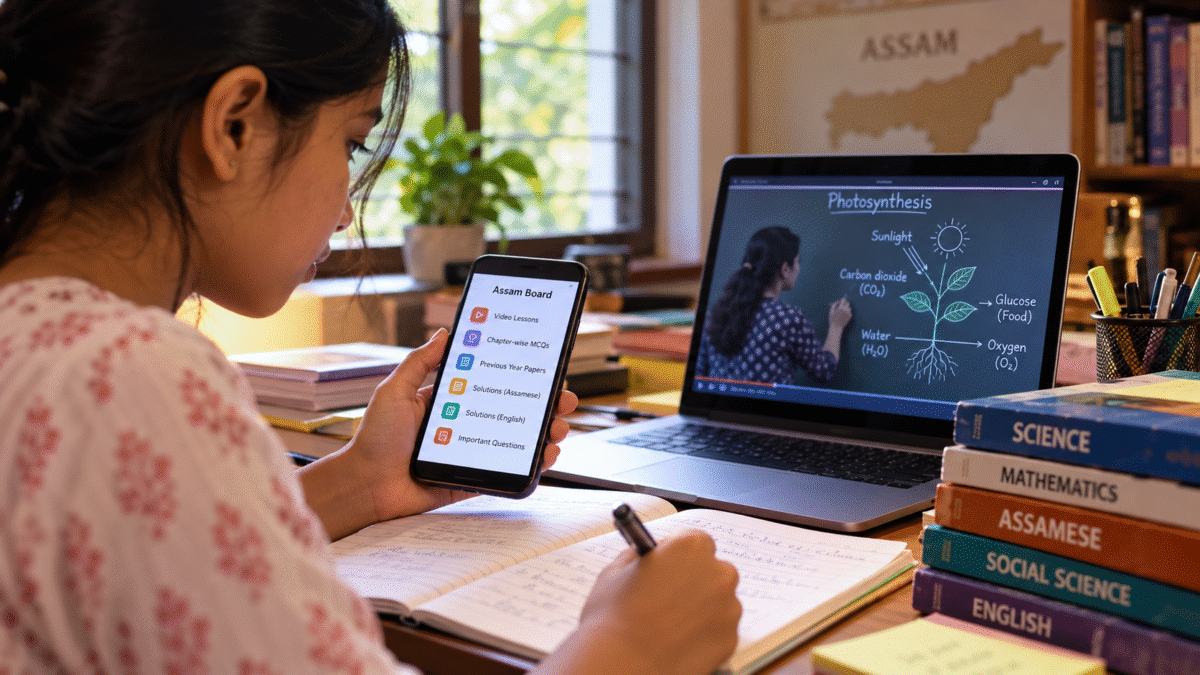
Regional-language resources, online practice and AI are opening new avenues for students—but questions of accuracy and access remain
By Jamal Ali
For generations, the textbook, classroom and teacher have formed the core of a student’s learning experience in Assam. That model is still firmly in place. But outside school hours, another layer of learning is increasingly taking shape on smartphones and computers.
Students are watching video lessons, searching for explanations of difficult chapters, downloading previous years’ question papers and practising multiple-choice questions online. For some, digital resources have become a convenient supplement to classroom teaching. For others, particularly those without access to private tuition or coaching centres, they can provide an additional source of academic support.
The change is not unique to Assam. But it raises a particular question for students following the state’s curriculum: how much of the enormous volume of educational material available online is actually relevant to them?
A student searching for a particular topic can encounter lessons designed for CBSE or ICSE students, material based on different syllabi and resources available only in English. Even when the subject is the same, the sequence of chapters, terminology, depth of treatment and examination requirements may differ.
This has created space for digital platforms that focus specifically on regional curricula.
From textbooks to screens
Digital learning does not necessarily mean replacing the textbook. In practice, it often works as an extension of it.
A student may read a chapter in the textbook and then turn to an online resource for a second explanation. Another may use an online question bank to test whether the chapter has been understood. Previous years’ examination papers can be used to become familiar with question formats, while solved answers can help students identify gaps in their own responses.
The shift is particularly relevant as students face examinations that require different forms of preparation. Objective questions demand quick recall and conceptual clarity, while descriptive questions require students to organise information and present it coherently.
Simply reading a chapter repeatedly may not be enough. Regular practice and self-assessment can help students identify what they know and, equally importantly, what they do not know.
Chapter-wise multiple-choice questions are one tool for this purpose. Instead of waiting until the end of the academic year to discover weaknesses, students can test themselves soon after completing a topic.
Previous years’ papers serve another purpose. They provide a practical picture of the kinds of questions students may encounter and can help them understand how much detail is expected in an answer.
The problem of too much content
The internet has solved one problem in education—access to information—but created another: finding the right information.
A simple online search can produce hundreds of results. Yet many may be irrelevant to the student’s syllabus, aimed at another board or based on outdated material.
For students preparing for state-board examinations, this can be particularly frustrating. A resource may explain a concept correctly but still be of limited use if its content does not correspond to the prescribed textbook or examination requirements.
This is where curriculum-specific educational websites are attempting to fill a gap.
One such example is Assam Eduverse, a platform focused on students following the Assam education system. It provides chapter-wise MCQs, solutions for Assamese- and English-medium students, important questions and previous years’ papers.
Its “chapter-wise MCQ section” (https://assameduverse.com/assam-board-mcqs/) is intended to allow students to practise after completing individual topics, while its “Assamese-medium solutions” (https://assameduverse.com/assamese-medium-solutions/) and “English-medium solutions” (https://assameduverse.com/assam-english-medium-solutions/) cater to students studying in the two mediums.
For students, the significance of such platforms is less about the technology itself and more about organisation. If relevant material can be found in one place, students spend less time searching and more time studying.
The importance of Assamese
Language remains an important part of this transition.
A student may be able to read English but still understand a complicated scientific, historical or social concept more easily when it is explained in Assamese. For Assamese-medium students, the availability of quality educational material in their own language can therefore make a practical difference.
But regional-language digital education involves more than translation.
Simply converting an English lesson into Assamese does not necessarily produce good educational material. The terminology, examples, explanations and questions must be appropriate to the curriculum and understandable to the students who will use them.
This is one reason curriculum-specific platforms can have relevance in a state where a substantial number of students continue to study through Assamese.
An alternative to expensive coaching?
Private tuition and coaching have become an important part of examination preparation for many students. But they also represent an additional financial burden for families.
Online resources cannot replicate everything that a teacher or coaching centre provides. A teacher can observe where a student is struggling, change an explanation, answer follow-up questions and provide motivation. A website cannot fully reproduce that interaction.
But digital material can provide something that is difficult to obtain through conventional tuition alone: unlimited repetition.
A student can attempt the same type of question several times, revisit a chapter late at night or return to a difficult explanation without having to wait for the next classroom session.
For students in rural or geographically isolated areas, digital access can potentially be even more significant—provided reliable internet connectivity and suitable devices are available.
That qualification is important. Digital education does not automatically eliminate inequality. Students without smartphones, computers, reliable connectivity or a suitable study environment can remain excluded from its benefits.
The emerging role of AI
Artificial intelligence could add another dimension to this changing educational landscape.
AI tools can already generate questions, explain concepts, summarise material and provide answers to students’ queries. In the future, such systems could potentially identify recurring mistakes and adapt practice exercises to individual students.
Regional languages could benefit significantly if AI systems become better at understanding and responding accurately in languages such as Assamese.
Imagine a student struggling with a particular concept being able to ask a question in Assamese and receive an explanation suited to their level of understanding. Such technology could make personalised learning more accessible.
But there is a significant caveat.
AI-generated educational material can be inaccurate. It can sometimes provide an apparently convincing answer that is simply wrong. It may also introduce information that falls outside the prescribed syllabus.
For school students, who may not have the knowledge to distinguish between a correct and incorrect explanation, this is a serious concern.
Human oversight therefore remains essential. Curriculum alignment, editorial review and the involvement of teachers and subject experts will continue to matter even as AI becomes more common.
Technology cannot replace the teacher
The growing use of digital resources should not be interpreted as evidence that traditional education is becoming obsolete.
The teacher remains central to the learning process. Classroom interaction, discussion, discipline, encouragement and the ability to understand an individual student’s difficulties cannot easily be replaced by an online platform.
The more realistic possibility is a blended model.
The textbook provides the foundation. The teacher provides instruction and context. Digital platforms provide additional explanations and practice. Question banks help students test themselves. Previous years’ papers familiarise them with examinations.
Each performs a different function.
The challenge is to ensure that these different components work together rather than compete with one another.
What comes next?
Assam’s education system is likely to see greater integration of digital learning in the years ahead. The important question will not simply be how much educational material is available online.
It will be whether that material is accurate, curriculum-aligned, accessible and understandable.
For Assamese-medium students, the language question will remain particularly important. If quality educational content becomes available in Assamese and is properly aligned with the state curriculum, digital learning could reduce some of the disadvantages faced by students who lack access to expensive supplementary education.
But technology alone cannot solve the larger challenges facing education. Access to devices and internet connectivity, teacher training, the quality of educational content and the ability of students to use digital tools effectively will all influence the outcome.
The future, therefore, may not be about choosing between the classroom and the smartphone.
It may be about making the two work together.
For an Assam student preparing for an examination, that could mean a familiar sequence: learn the chapter from the textbook and teacher, use digital resources to clarify difficult points, practise questions, review mistakes and return to the textbook for revision.
The technology is changing. The basic purpose of education is not.
The real test will be whether these new tools help students understand more, practise better and learn with greater confidence.